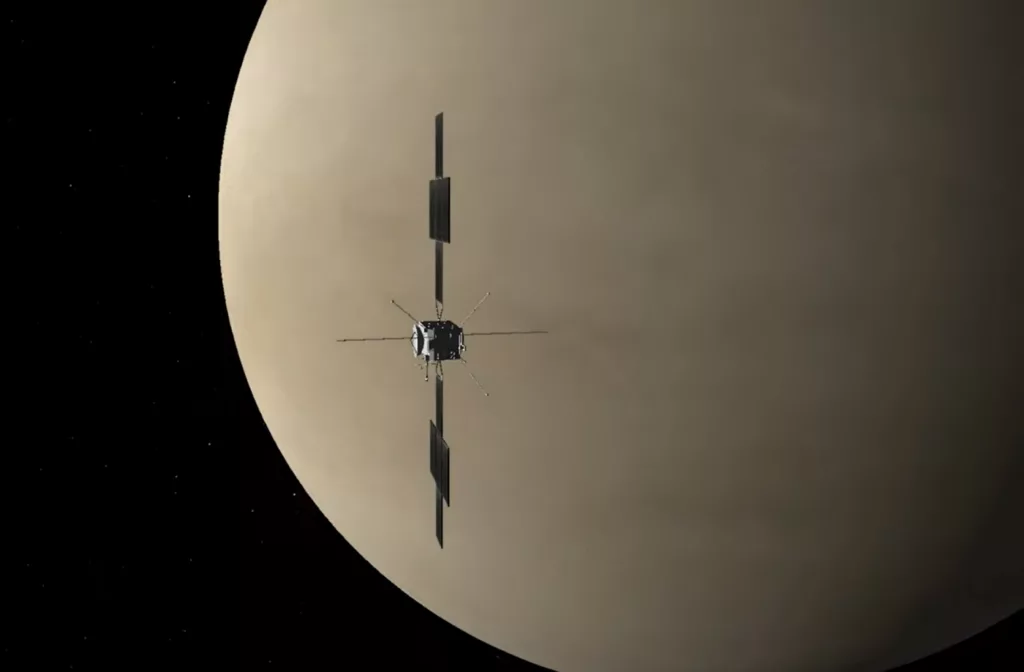
Recently, the European Space Agency’s Jupiter Icy Moons Explorer (“Juice”) flew past Venus in a flawless gravity-assist maneuver. During the encounter, Juice passed closest to Venus at a distance of 5088 km while carefully shielding itself from the Sun’s heat using its high-gain antenna as a thermal shield.
No science observations were made due to the extreme thermal environment. However, this time the flyby was not about science, its main purpose was to bend Juice’s orbit around Venus and give it the extra speed needed to continue the long journey to Jupiter.
Just a few weeks earlier, the mission team had resolved a challenging spacecraft communication anomaly: Juice had fallen silent, cutting off all telemetry and raising fears it had entered survival mode. Thanks to rapid teamwork by Airbus (Juice’s manufacturer) and the teams at ESA’s European Space Operations Centre (ESOC) in Germany – including the colleagues from SSC who played a key role in planning the flyby and monitoring spacecraft telemetry – communication could be restored after nearly 20 hours, clearing the way for this critical flyby.
“There is always great excitement around the time of a flyby. We train hard to be able to respond to different contingency scenarios, but something unpredictable could always happen. Thankfully, it was a smooth flyby, and Juice once again proved to be a remarkable spacecraft,” said Carmine Formisano, Spacecraft Operations Engineer at SSC.
Executing such a maneuver requires extraordinary precision: Even a small navigation error at Venus could ripple into thousands of kilometers of offset years later. After months of planning and fine-tuning of Juice’s trajectory, the flyby delivered exactly the boost required.
A huge shoutout to European Space Agency – ESA – and everyone involved in making this milestone possible!
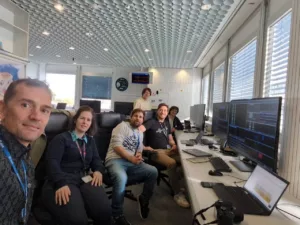
Special recognition to our team, who played a key role in planning the flyby and monitoring spacecraft telemetry during multiple ground station contacts—especially over Cebreros during closest approach. Their dedication and expertise were vital to the mission’s success.
Juice is now on course using a carefully planned series of four gravity-assist flybys at Earth and Venus to gradually reach the speed needed to get to Jupiter, where it will arrive in 2031 to begin detailed exploration of the planet and its icy moons Ganymede, Callisto, and Europa as potential ocean worlds and habitats.
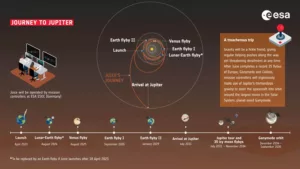
Image credits: ESA
Read more about the Juice mission at ESA’s website: https://www.esa.int/Science_Exploration/Space_Science/Juice